Color Gradients in Massive Quiescent Galaxies
Spatially resolved stellar populations ease model tensions at z>3
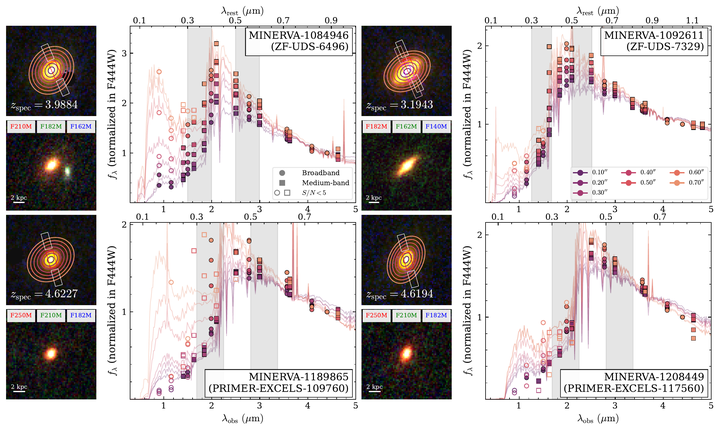
Using JWST medium-band photometry from the MINERVA treasury survey, this project characterizes spatially resolved stellar populations in massive quiescent galaxies at z>3 — a population whose extreme early formation timescales have created significant tensions with galaxy formation models.
Cutler et al. 2026 — Color Gradients at z>3
The Astrophysical Journal Letters, doi:10.3847/2041-8213/ae960c | arXiv:2606.02698
We measure resolved photometry in a series of elliptical annuli out to 0.″7 (~4 Rₑ) for four log(M★/M☉)>11 quiescent galaxies at z>3, using MINERVA’s medium-band NIRCam imaging to track the rest-frame U − V and V − J colors as a function of radius. Three of the four galaxies show clear negative color gradients (bluer outskirts, redder cores) consistent with inside-out assembly and declining stellar ages at larger radii.
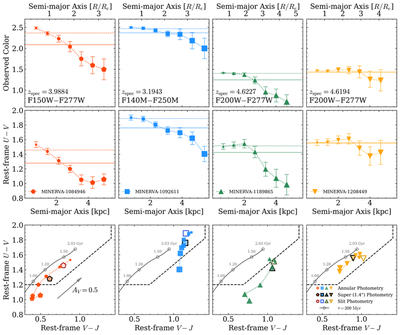
For the steepest gradient (Δ(U − V)/ΔR = −0.126 ± 0.030 mag kpc⁻¹), the inferred stellar mass is 0.1 dex lower than when measured within a fiducial NIRSpec slit, which samples only the galaxy core. Propagating this correction through extreme-value statistics models reduces the tension with ΛCDM predictions out to z ~ 9.5 — easing, though not eliminating, the too-early star formation problem.
These findings underscore the importance of integral field unit (IFU) spectroscopy for massive high-z quiescent galaxies: spatially resolved spectra are needed to break the age–dust–metallicity degeneracy and reliably disentangle the effects of color gradients from those of different physical modeling assumptions.