Globular Clusters at z~2.5
The Relic hosts young (<8 Myr) globular clusters with enchanced Helium abundance
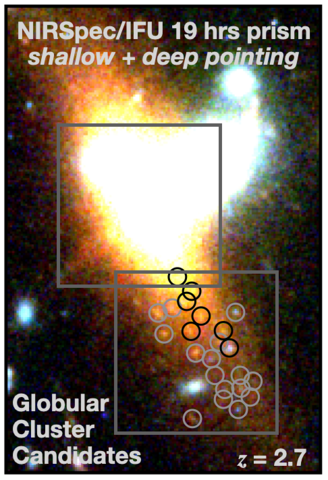
Enhanced sensitivity and spatial resolution from JWST+gravitational lensing allow us to detect and resolve candidate globular clusters (GCs) in a massive, z>2.5 quiescent galaxy: The Relic
The Relic I: Photometric Analysis - Whitaker et al. 2026
The Astrophysical Journal, doi:10.3847/1538-4357/ae5177 | arXiv:2501.07627
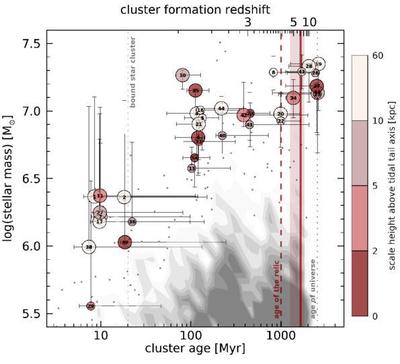
Using deep JWST imaging from UNCOVER and MegaScience, we discover 36 candidate GCs within the Relic, a massive quiescent galaxy at z=2.5 in the Abell 2744 lensing field. The clusters span formation ages from 8 Myr to ~2 Gyr, tracing a rich assembly history back to z~10, with masses of ~10⁶–10⁷ M☉ consistent with precursors to the most-massive present-day GCs. Their spatial distribution and low metallicities point to a combination of early in situ formation and later cluster accretion, providing the first direct link between high-redshift star cluster populations and local GCs.
The Relic II: IFU PRISM Spectroscopy - Cutler et al. in prep.
We obtained deep (14.5 hr) NIRSpec/IFU PRISM spectroscopy for the Relic in Cycle 3 (JWST-GO-6405, PIs: Cutler/Whitaker). Following initial data reduction, we found distinct emission lines (e.g., Hα+[NII], [OIII]+Hβ) in two young, blue GCs. Using spectrophotometric modeling, we confirmed the redshift of these GCs to be consistent with the cluster and found ages as young as 6 Myr. Notably, these young GCs show significant HeI 10830 emission, suggesting self-enrichment from:
- Active enrichment from very massive star or Wolf-Rayet stellar winds
- Enrichment of birth gas prior to star formation
- Delayed enrichment after the first ~2 Myr